


Understanding Hybrid Cloud for Fort Worth Dental Practices
- IndustriousTechSolutions

- 4 hours ago
- 10 min read
Understanding Hybrid Cloud for Fort Worth Dental Practices
Defining the Hybrid Model
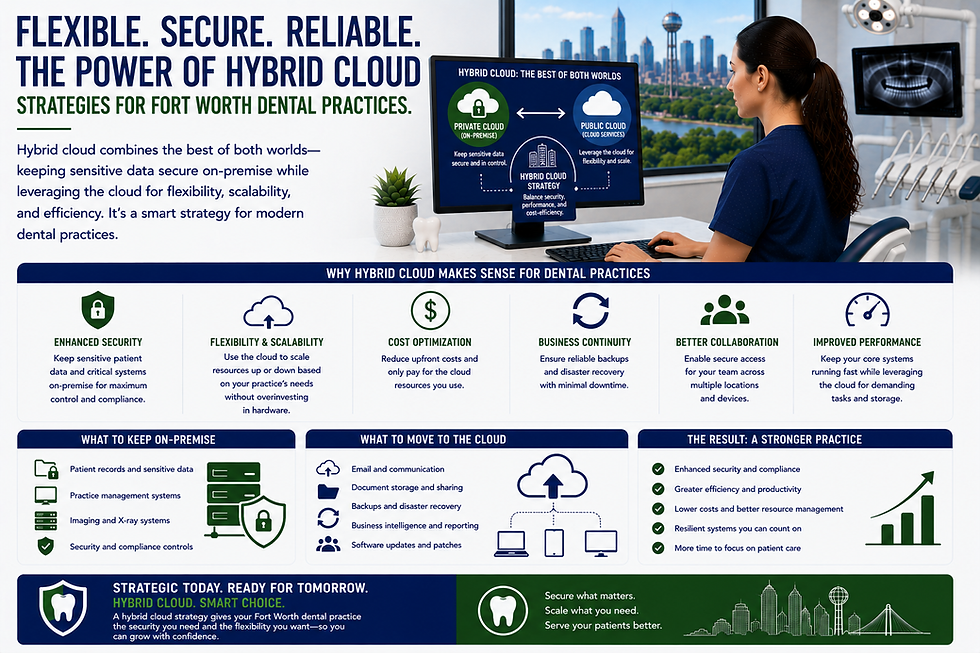
Modernizing a practice often requires a sophisticated approach to infrastructure, and finding the right dental IT support can make the difference between a seamless transition and a series of technical hurdles. For many clinics in Fort Worth, a hybrid cloud strategy offers a balanced solution that combines the security of local data storage with the flexibility of the cloud. This model allows practices to maintain their critical applications on-site while leveraging remote servers for backups, collaboration, and high-performance computing tasks. By integrating these two environments, dental professionals can ensure that their patient records are accessible yet protected by multiple layers of redundancy.
Benefits of On-Site Reliability
Maintaining a local server remains a popular choice for dental offices that prioritize immediate access to high-resolution imaging and patient records. When a database is hosted on-site, the practice is less dependent on an external internet connection for day-to-day operations, such as checking in patients or viewing intraoral scans. This localized approach minimizes latency and provides a sense of control over sensitive data. In a hybrid environment, the local server serves as the primary hub for active patient files, ensuring that the clinical workflow remains uninterrupted even if there are temporary issues with the broader network.
Scalability of the Cloud
The cloud component of a hybrid strategy provides the scalability that local hardware often lacks. As a practice grows and accumulates more data, expanding physical storage can be costly and labor-intensive. Cloud services allow for nearly infinite storage expansion without the need for additional server racks or cooling systems. This flexibility is particularly valuable for clinics that are expanding their services or adding new locations across the DFW metroplex. By offloading non-critical or archival data to the cloud, practices can maintain high performance on their local machines while keeping historical records securely stored and easily retrievable.
Bridging the Gap Between Local Servers and Cloud Infrastructure
Managing Practice Management Software
The core of any dental office is the practice management software, which handles everything from scheduling to billing and treatment planning. Many traditional platforms were designed to run on local area networks, making a full cloud migration complex. A hybrid strategy allows these systems to continue running on a local server while utilizing cloud-based modules for patient portals, automated reminders, and insurance verification. This middle-ground approach preserves the stability of the core software while introducing modern features that enhance the patient experience and streamline administrative tasks.
Integration with Dentrix and Eaglesoft
For practices utilizing Dentrix or Eaglesoft, a hybrid setup is often the most practical way to modernize. These established platforms are frequently built on a client-server architecture that benefits from the speed of a local connection. However, by adding cloud-based backup and mobile access modules, the practice can extend the functionality of these tools beyond the office walls. This allows providers to review charts or schedules from home securely, provided that the dental IT support team has implemented robust virtual private networks and encryption protocols to protect the data during transmission.
The Role of Open Dental in Hybrid Environments
Open Dental has become increasingly popular due to its flexible database structure, which lends itself well to hybrid configurations. Because it uses a SQL-based backend, the data can be mirrored or backed up to cloud-based SQL instances for enhanced disaster recovery. Many offices in North Texas choose to host the main database on-site for peak performance during clinical hours while using cloud-based services for secondary reporting and data analysis. This architectural flexibility makes it easier for IT professionals to design a system that meets the specific performance and security requirements of a busy dental clinic.
Maintaining Compliance with HIPAA and Texas HB 300 in DFW
Federal HIPAA Security Rule Requirements
Compliance is a non-negotiable aspect of dental IT support for DFW dental practices, particularly when managing data across a hybrid environment. The HIPAA Security Rule mandates specific administrative, physical, and technical safeguards to ensure the confidentiality and integrity of protected health information. In a hybrid model, this means that both the local server and the cloud storage provider must meet stringent encryption standards. Business Associate Agreements must be in place for all third-party vendors, and the practice must conduct regular risk assessments to identify and mitigate potential vulnerabilities in the network.
Understanding Texas Medical Records Privacy Act Enhancements
While HIPAA provides a federal baseline, Texas HB 300 significantly expanded the protections offered under the Texas Medical Records Privacy Act. For practices operating in Fort Worth and the surrounding areas, this state law introduces stricter requirements, including a broader definition of covered entities and mandatory privacy training for all employees. HB 300 also imposes more significant penalties for data breaches and requires faster notification times in certain circumstances. A hybrid cloud strategy must be designed with these Texas-specific regulations in mind to ensure that the practice remains fully compliant at both the state and federal levels.
Navigating Stricter Local Breach Notifications
One of the critical differences between federal regulations and Texas state law is the timeline for reporting a security incident. Under Texas HB 300, the window for notifying affected individuals and state authorities can be shorter than what is allowed under the HIPAA Breach Notification Rule. This necessitates a proactive monitoring system within the hybrid infrastructure that can detect unauthorized access in real-time. By utilizing cloud-based security logging and local intrusion detection systems, a practice can respond quickly to any potential threats, thereby fulfilling its legal obligations and protecting its reputation within the Dallas community.
Data Security and Digital Identity Guidelines in North Texas
Applying NIST SP 800-63B Standards
To ensure the highest level of security, many dental IT support providers in North Texas are looking toward the NIST SP 800-63B guidelines for digital identity management. These standards provide a framework for creating secure authentication processes that go beyond simple passwords. In a hybrid cloud environment, where users may be accessing data from multiple devices and locations, following these guidelines helps prevent unauthorized access. This includes implementing modern password policies that focus on length and complexity rather than frequent expiration, which often leads to poor security habits among staff members.
Multi-Factor Authentication in Dental Offices
Multi-factor authentication (MFA) is a critical component of the NIST guidelines and a vital tool for any Dallas dental clinic. By requiring a second form of verification—such as a code sent to a mobile device or a biometric scan—MFA makes it significantly harder for bad actors to compromise an account. In a hybrid setup, MFA should be implemented for accessing the local server, the cloud storage platform, and any remote desktop connections. This layer of security is especially important for protecting remote access points, which are often targeted by opportunistic attackers looking for an easy entry into the network.
Encryption for Data at Rest and in Transit
Data protection must be consistent across all parts of a hybrid infrastructure. Encryption should be applied to data at rest, meaning the files stored on the local hard drives and the cloud servers are unreadable without the correct decryption key. Additionally, data in transit—the information moving between the office and the cloud—must be protected using secure protocols such as Transport Layer Security. Ensuring that encryption is properly configured requires specialized dental IT support to manage the keys and certificates that keep patient information safe from prying eyes during every stage of the data lifecycle.
Optimizing Network Performance for Dallas Clinics
Bandwidth Requirements for Hybrid Solutions
A successful hybrid cloud strategy depends heavily on the quality of the office's internet connection. Because data is constantly being synced between the local server and the cloud, sufficient bandwidth is required to prevent bottlenecks. For a typical Dallas dental office, this means investing in a high-speed business-grade connection with symmetrical upload and download speeds. Without adequate bandwidth, staff may experience delays when uploading large digital X-rays or accessing cloud-based patient portals, which can lead to frustration and decreased efficiency in the clinic.
Low-Latency Connections for Local Database Access
While the cloud handles many tasks, the local database remains the primary point of interaction for clinical work. To ensure that the practice management software remains responsive, the internal network must be optimized for low latency. This involves using high-quality networking hardware, such as gigabit switches and professional-grade cabling, to connect workstations to the server. By maintaining a high-performance local area network, the practice can enjoy the speed of on-site hosting while still reaping the benefits of the hybrid model's cloud-based features.
Redundant Internet Connections for Cloud Access
Given the reliance on the cloud for backups and essential services, internet downtime can be a major disruption. Many North Texas practices choose to implement redundant internet connections from different providers to ensure constant connectivity. If the primary fiber connection fails, the network can automatically failover to a secondary cable or wireless link. This redundancy is a hallmark of a well-designed hybrid strategy, as it ensures that the cloud-based components of the system remain accessible even during local outages, allowing the office to continue its administrative and communication functions without a hitch.
Business Continuity and Disaster Recovery Strategies
Local Backups for Immediate Restoration
The first line of defense in any disaster recovery plan is a local backup system. In a hybrid cloud model, the local server is backed up frequently to an on-site storage device, such as a Network Attached Storage (NAS) unit. This allows for the rapid restoration of files in the event of a hardware failure or accidental deletion. Because the data does not need to be downloaded from the internet, the recovery time is minimal, allowing the practice to resume operations quickly. Regular testing of these local backups is essential to ensure that the data is valid and can be restored when needed.
Cloud Replications for Catastrophic Events
Local backups alone are not enough to protect a practice from catastrophic events such as fire, flood, or theft. This is where the cloud component of the hybrid strategy becomes indispensable. By replicating the local backups to a secure, off-site cloud facility, the practice ensures that its data survives even if the physical office is destroyed. These cloud-based backups are often stored in multiple geographic locations to provide even greater resilience. For a clinic in Fort Worth, having an off-site copy of patient records is a critical step in meeting regulatory requirements for data preservation and business continuity.
Testing Recovery Protocols Regularly
A disaster recovery plan is only effective if it is regularly tested and updated. Dental IT support teams should conduct periodic drills to simulate different types of data loss scenarios, from a single file recovery to a full system restoration from the cloud. These tests help identify any gaps in the protocol and ensure that the staff knows how to respond in an emergency. In the fast-paced environment of a North Texas dental office, knowing that the data is protected and that a clear path to recovery exists provides peace of mind for both the practice owners and their patients.
The Cost-Effectiveness of Hybrid Infrastructure
Balancing Capital Expenditures and Operating Costs
One of the primary advantages of a hybrid cloud strategy is the ability to balance capital expenditures with operating costs. Traditional IT models often require large, infrequent investments in expensive server hardware. With a hybrid approach, the practice can maintain a smaller, more affordable on-site server while using a predictable monthly subscription for cloud services. This makes budgeting more manageable for many dental offices in the DFW area, as it replaces large, unpredictable costs with a stable operating expense that can be scaled up or down based on the practice's current needs.
Reducing Hardware Replacement Cycles
By offloading resource-intensive tasks to the cloud, practices can often extend the lifespan of their local hardware. When the local server is not responsible for every single computing task, it experiences less wear and tear and remains performant for a longer period. This reduces the frequency of expensive hardware replacements and minimizes the downtime associated with migrating to new systems. For many practitioners in North Texas, this translates to a better return on investment for their IT infrastructure and a more sustainable approach to technology management over the long term.
Enhancing Productivity Through Modern Systems
Investment in a hybrid cloud strategy is also an investment in the productivity of the dental team. Modern systems that integrate local speed with cloud-based collaboration tools allow staff to work more efficiently. For example, clinical staff can capture images quickly on the local network, while administrative staff can manage insurance claims through a cloud-based portal simultaneously. This streamlined workflow reduces bottlenecks and allows the practice to see more patients while maintaining a high standard of care. Over time, the efficiency gains provided by a well-implemented hybrid system can significantly outweigh the initial setup costs.
Implementation Best Practices for North Texas Dentists
Assessing Current IT Infrastructure
The first step in moving to a hybrid cloud model is a comprehensive assessment of the current IT environment. This involves evaluating the age and performance of existing servers, workstations, and networking equipment. It also requires a thorough review of the software being used and how it interacts with the network. A professional dental IT support provider will look for potential vulnerabilities and identify which components are ready for the cloud and which should remain local. This assessment forms the foundation of a customized strategy that aligns with the practice's specific goals and budget.
Phased Migration to Cloud Services
A successful transition to a hybrid model is rarely done all at once. Instead, a phased migration approach is often recommended to minimize disruption to the clinical schedule. This might begin with moving backups to the cloud, followed by implementing cloud-based email and communication tools. Once these foundational elements are stable, more complex integrations, such as cloud-linked practice management modules, can be introduced. This gradual process allows the staff in a Dallas office to adapt to new workflows at a manageable pace while ensuring that each component of the system is functioning correctly before moving to the next stage.
Ongoing Support and Maintenance Requirements
A hybrid cloud environment requires ongoing monitoring and maintenance to ensure it remains secure and efficient. This includes regular software updates, security patching, and performance tuning for both the local and cloud-based systems. Having access to dedicated dental IT support is essential for managing these tasks and responding quickly to any technical issues that may arise. For practices in North Texas, partnering with a managed service provider who understands the unique needs of the dental industry ensures that the technology continues to support the practice's mission rather than becoming a source of stress.
Key Takeaways
Hybrid Strategy: A combination of local servers and cloud services provides the best balance of speed, security, and scalability for modern clinics.
Local Reliability: Maintaining an on-site server ensures that clinical workflows remain fast and are not entirely dependent on internet connectivity.
Regulatory Compliance: Adhering to both the federal HIPAA Security Rule and the stricter Texas HB 300 is essential for avoiding penalties and protecting patient data.
Security Standards: Implementing NIST SP 800-63B guidelines and multi-factor authentication significantly reduces the risk of unauthorized access.
Network Optimization: High-speed internet and redundant connections are critical for maintaining the performance of cloud-linked dental systems.
Disaster Recovery: A robust plan includes both local backups for quick recovery and cloud replication for protection against catastrophic events.
Cost Management: Hybrid models help stabilize IT budgets by balancing hardware investments with predictable monthly cloud service fees.
Professional Support: Partnering with experienced IT professionals ensures that the hybrid infrastructure is correctly implemented and maintained.
Adopting a hybrid cloud strategy is a forward-thinking move for any dental practice looking to enhance its operational efficiency and data security. By carefully balancing the strengths of local and cloud-based resources, practitioners in the DFW area can build a resilient infrastructure that meets the demands of modern dentistry. Navigating these technical choices requires a deep understanding of both technology and the specific regulatory landscape of the healthcare industry. To ensure your office is equipped with the best possible tools, consider reaching out to experts who specialize in providing comprehensive dental IT support for DFW dental practices.


Comments