


Understanding the Critical Nature of HIPAA for Dallas Dental Offices

Updated: May 11
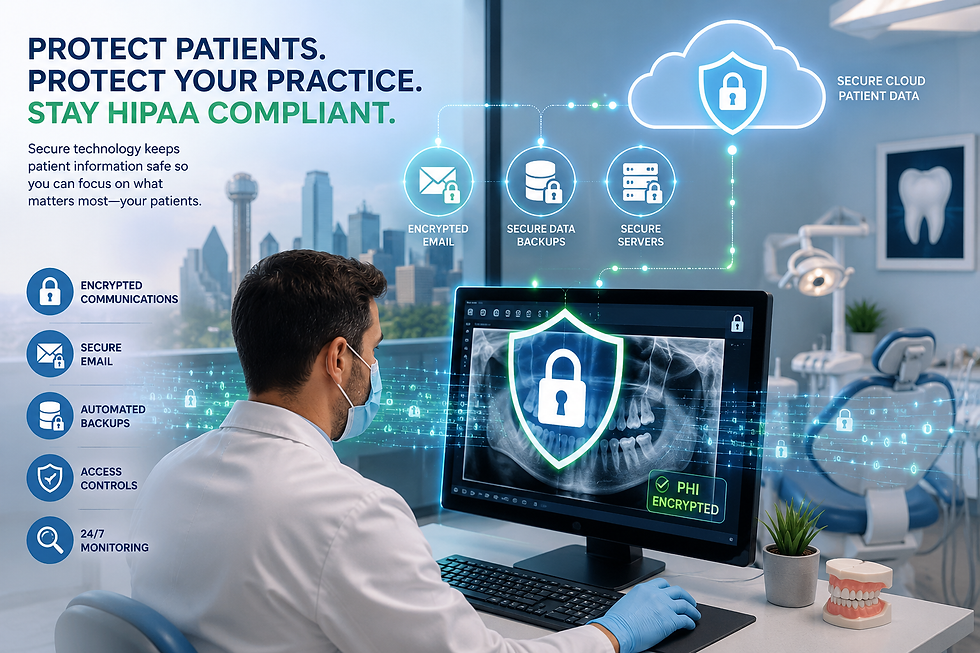
The Intersection of Patient Care and Data Security
HIPAA compliance represents the cornerstone of trust between a patient and their dental provider. In an era where digital records are the standard, securing sensitive personal information is no longer just a technical requirement but a core component of clinical excellence. For those seeking reliable dental IT support, understanding the complexities of federal and state regulations is the first step toward building a resilient practice. Dallas dental offices must treat data protection with the same rigor they apply to sterilization and patient safety, ensuring that every interaction remains confidential and secure. When clinicians prioritize the integrity of patient records, they foster a professional environment that values privacy as much as physical health.
Defining the Modern Threat Landscape for North Texas Practices
Ransomware and phishing attacks have become increasingly sophisticated, often targeting small to mid-sized healthcare providers throughout North Texas. Cybercriminals recognize that dental offices house valuable datasets, including social security numbers, insurance details, and medical histories. Without a proactive approach to security, a single click on a malicious link could compromise years of patient records and lead to significant operational disruptions. Many practices in the region have observed that generic security measures are no longer sufficient to defend against targeted threats. Implementing specialized defense strategies is essential for maintaining the continuity of care in an increasingly digital landscape.
Why Professional Dental IT Support is Essential
Navigating the technical requirements of the HIPAA Security Rule requires specialized knowledge that often exceeds the capacity of internal clinical staff. Engaging with a provider of dental IT support ensures that your network architecture is designed with compliance as its primary foundation. These professionals provide continuous monitoring, threat detection, and system optimization tailored specifically for the unique workflows of a dental office. By outsourcing these complex tasks, practice owners in Fort Worth can maintain high standards of data integrity without sacrificing their focus on patient outcomes. A professional partnership allows for the implementation of enterprise-grade security controls at a scale appropriate for a local clinic.
Navigating the HIPAA Security Rule and Federal Standards
Administrative Safeguards for Practice Management
The HIPAA Security Rule outlines specific administrative safeguards that govern how a practice manages its workforce and information systems. This includes the development of formal security policies, the designation of a dedicated security official, and the performance of regular risk analysis. For a DFW clinic, these policies must be more than just documents on a shelf; they must be living protocols that dictate how staff interact with electronic protected health information. Effective administration ensures that every employee understands their role in maintaining a secure environment and follows established procedures for data handling. Consult your compliance officer to ensure these administrative measures are fully integrated into your daily operations.
Physical Protections for Local Server Infrastructure
While digital threats receive significant attention, the physical security of hardware is equally important under federal guidelines. Servers, workstations, and portable devices must be protected from unauthorized access, theft, or environmental damage through controlled access measures. A Dallas practice might implement badge access for server rooms or utilize hardware locks for front-desk computers. Ensuring that patient-facing screens are positioned to prevent unauthorized viewing is another critical aspect of physical security that is often overlooked. These tangible measures form the first line of defense against local data breaches and physical tampering with sensitive equipment.
Technical Safeguards and Encryption Requirements
Technical safeguards involve the use of specialized technology to protect data and control access to information systems. This includes the implementation of unique user identifications, emergency access procedures, and automatic log-offs to prevent unauthorized session persistence. Encryption is a key component here, ensuring that even if data is intercepted during a breach, it remains unreadable to unauthorized parties. Whether data is at rest on a server in Fort Worth or in transit via email, robust encryption protocols are necessary to meet the high standards set by federal law. Utilizing advanced encryption standards helps protect the integrity of the patient record from external interference.
Comparing HIPAA with Texas HB 300 and State Requirements in North Texas
Enhanced Privacy Protections under the Texas Medical Records Privacy Act
Practices operating in North Texas must be aware that state law often imposes requirements that are stricter than those found at the federal level. Texas HB 300, which amended the Texas Medical Records Privacy Act, expanded the definition of a covered entity and significantly increased the penalties for non-compliance. This means that a wider range of businesses involved in the handling of health data are subject to rigorous state oversight. Understanding these nuances is vital for dental offices that want to avoid the legal and financial repercussions of a state-level investigation. Reviewing state-specific requirements with legal counsel is an essential step in maintaining a comprehensive compliance program.
Stricter Breach Notification Timelines for DFW Clinics
One of the most significant differences introduced by Texas HB 300 is the shortened timeline for reporting data breaches to affected individuals and state authorities. While HIPAA allows for a longer notification period, Texas law requires businesses to notify affected parties within a more aggressive timeframe following the discovery of a breach. For a DFW dental practice, having an incident response plan that accounts for these state-specific deadlines is crucial for legal protection. Failing to report a breach promptly can lead to increased fines from the Texas Attorney General’s office, even if federal requirements have been met. Speed and transparency are essential components of a compliant response strategy.
Mandatory Employee Training and Accountability Standards
Training requirements under Texas HB 300 are more specific than those found in federal regulations, requiring customization based on the practice's unique workflows. All employees who handle protected health information must receive training tailored to the requirements of the Texas Medical Records Privacy Act. This training must be documented and updated regularly to reflect changes in technology or law. In the competitive landscape of Dallas dentistry, maintaining a well-trained staff not only ensures compliance but also fosters a culture of accountability. Empowering your team with the knowledge to identify risks is one of the most effective ways to protect your practice from internal and external threats.
Implementing NIST SP 800-63B Guidelines in Fort Worth
Modern Multi-Factor Authentication for Clinical Staff
Digital identity management has evolved rapidly, and the NIST SP 800-63B guidelines provide a rigorous framework for secure authentication in a healthcare setting. For a Fort Worth dental clinic, this often translates to the implementation of multi-factor authentication for all system logins. Multi-factor authentication requires staff to provide two or more verification factors to gain access to sensitive systems, significantly reducing the risk of unauthorized entry through compromised passwords. Utilizing biometric data or hardware tokens can provide a higher level of assurance than traditional SMS-based codes. These modern protocols align with the highest standards of cybersecurity and protect the practice from common credential-harvesting attacks.
Managing Secure Access to Eaglesoft and Dentrix Systems
Practice management software like Dentrix or Eaglesoft serves as the heart of the dental office, containing vast amounts of sensitive patient data. Managing who has access to these systems, and under what conditions, is a central part of a professional dental IT support strategy. By following NIST guidelines, practices can implement least-privilege access, ensuring that staff members only have the permissions necessary to perform their specific job functions. This limits the potential impact if an individual account is ever compromised by an external threat. Regular reviews of user permissions help maintain a secure environment as staff roles evolve over time.
The Role of Digital Identity in Preventing Unauthorized Access
Verifying the identity of every user on a network is essential for maintaining a secure perimeter around sensitive clinical data. In a busy Dallas clinic, the constant movement of staff between treatment rooms and administrative areas can lead to security lapses if systems are left unattended. Implementing automated session timeouts and robust password complexity policies helps maintain the integrity of the digital environment. By treating digital identity as a dynamic asset rather than a static credential, North Texas dental practices can better defend against unauthorized access attempts. Consistent application of these standards ensures that only verified individuals can interact with patient records.
Securing Mainstream Dental Practice Management Systems
Database Encryption and Security for Open Dental Users
Open Dental and other popular management tools offer various security features that must be correctly configured to ensure full regulatory compliance. Database encryption is perhaps the most critical configuration, as it protects the core repository of patient information from unauthorized extraction. For a North Texas practice, ensuring that the database is not only encrypted but also backed up securely is a non-negotiable requirement for business continuity. Regular audits of system logs can help identify unusual activity, allowing for the early detection of potential security incidents. Working with technical experts ensures that these complex configurations are maintained correctly over the long term.
Integrating Third-Party Imaging with Core Clinical Workflows
Modern dentistry relies heavily on digital imaging, ranging from standard X-rays to advanced intraoral scans. These high-resolution files are often managed by third-party applications that must integrate seamlessly with the primary practice management software. Ensuring that these integrations do not create security vulnerabilities is a key task for those providing dental IT support. Data must remain encrypted as it moves between different software platforms to prevent interception or accidental exposure. Access to imaging databases should be as strictly controlled as access to the main patient chart to maintain a consistent security posture across the entire clinical workflow.
Maintaining Compliance During Software Updates and Migrations
Software updates are necessary for both functionality and security, but they can also introduce new risks if not managed with professional oversight. During a system migration or a major version update, patient data is at its most vulnerable due to changes in database structures and security protocols. A DFW dental practice should work closely with their IT partners to ensure that security configurations are maintained throughout the update process. Testing the environment after an update is completed is essential to verify that encryption and access controls are still functioning as intended. This proactive approach prevents accidental data exposure and ensures that the practice remains compliant at all times.
Conducting Comprehensive Security Audits in North Texas
Identifying Vulnerabilities in Local Area Networks
A security audit is a systematic evaluation of a practice's information systems to determine how well they conform to established regulatory criteria. For a Fort Worth clinic, this involves scanning the local area network for vulnerabilities such as open ports, unpatched hardware, or weak wireless configurations. Identifying these weaknesses allows the practice to prioritize remediation efforts and strengthen its overall security posture against potential attackers. Regular audits are a specific requirement under the HIPAA Security Rule and are vital for staying ahead of evolving digital threats. Understanding your vulnerabilities is the first step toward building a truly secure clinical environment.
Reviewing Business Associate Agreements with IT Vendors
Any third-party vendor that has access to protected health information is considered a business associate under federal guidelines. This includes IT service providers, cloud storage companies, and even some maintenance contractors who may interact with clinical systems. A Dallas dental office must have signed Business Associate Agreements in place that clearly define the vendor's responsibilities regarding data protection. Reviewing these agreements periodically ensures that all partners are adhering to the necessary standards and that the practice is not assuming unnecessary liability. Clear contractual obligations help protect the practice in the event of a vendor-related security incident.
Creating a Roadmap for Continuous Compliance Improvement
Compliance is not a one-time event but a continuous process of assessment, remediation, and improvement. An audit should result in a detailed report that outlines specific actions for enhancing security based on the identified risks. For a North Texas practice, this roadmap might include upgrading legacy hardware, implementing new training programs, or migrating to more secure cloud-based solutions. By treating compliance as a journey rather than a destination, dental offices can build a culture of security that adapts to new technologies. Continuous improvement ensures that the practice remains resilient in the face of ever-changing regulatory and technical challenges.
Data Resilience and Disaster Recovery Strategies for DFW Dentists
Redundant Storage Solutions for High-Resolution Patient Images
Data loss can be just as devastating to a practice as a data breach, leading to significant financial and clinical setbacks. Implementing redundant storage solutions ensures that if one hard drive or server fails, the information remains accessible through a secondary system. For a Dallas dental office, this is particularly important for high-resolution imaging files that are difficult and expensive to recreate if lost. Utilizing a combination of local and cloud-based storage provides a reliable safety net that protects the practice's most valuable digital assets. Redundancy is a fundamental principle of data resilience that minimizes the impact of hardware failures.
Testing Restoration Protocols to Ensure Business Continuity
Having a backup is only half of the solution; the ability to restore that data quickly is what ensures business continuity during a crisis. Practices in Fort Worth should regularly test their restoration protocols to confirm that data can be recovered within an acceptable timeframe. If a server goes down on a busy morning, the office needs to know exactly how long it will take to get back online and resume patient care. This proactive testing minimizes downtime and ensures that the practice can recover from a technical failure without significant disruption. A verified recovery plan is an essential component of any modern dental IT support strategy.
Encrypted Off-Site Storage and the HIPAA Security Rule
The HIPAA Security Rule requires that backups be stored in a secure, off-site location to protect against local catastrophes like fire, flooding, or theft. For a North Texas clinic, this off-site storage must be fully encrypted and managed by a compliant vendor to ensure data integrity. Ensuring that data is encrypted during the transfer process and while at rest in the remote data center is a critical technical requirement. By adhering to these standards, dental practices can rest assured that their patient records are safe and accessible, no matter what happens to their physical location. Secure off-site storage provides the ultimate peace of mind for practice owners.
Building a Security-First Culture in Fort Worth
Social Engineering Awareness and Phishing Defense
The most advanced technical controls can be undermined by a single human error or a lapse in judgment. Social engineering attacks, such as phishing, trick employees into revealing passwords or downloading malware through deceptive communication. Training staff to recognize the signs of a suspicious email or phone call is a vital component of a modern security strategy for any Fort Worth clinic. Fostering an environment where employees feel comfortable questioning unusual requests and reporting potential security incidents is essential for early detection. A security-aware staff is the most effective defense against the psychological tactics used by modern cybercriminals.
Role-Based Access Controls for Administrative and Clinical Staff
Implementing role-based access controls ensures that individuals only have access to the information they need to perform their specific job functions. An office manager in Dallas may need access to financial records, while a dental assistant only needs to view clinical notes and schedules. By limiting access in this way, the practice reduces the risk of accidental or intentional data misuse from within the organization. This principle of least privilege aligns with both HIPAA requirements and the NIST SP 800-63B guidelines for digital identity management. Regular reviews of these roles ensure that access permissions remain aligned with the current needs of the practice.
Documenting Security Incidents and Internal Responses
When a security incident occurs, whether it is a minor policy violation or a more significant data concern, thorough documentation is essential for regulatory compliance. This documentation should include the nature of the event, how it was discovered, the steps taken to mitigate the damage, and any changes made to prevent a recurrence. For a DFW dental office, these records are crucial for demonstrating compliance to regulators, insurance providers, and patients. A well-documented response shows that the practice takes its security obligations seriously and is committed to transparent operational standards. Accurate record-keeping is a hallmark of a professionally managed dental practice.
Key Takeaways for DFW Dental Practices
Summary of Safeguards and Standards
Maintaining a secure and compliant dental practice in the Dallas-Fort Worth area requires a multi-layered approach to technology and policy. By focusing on the following key areas, practice owners can build a robust defense against modern threats while satisfying federal and state regulatory requirements. These takeaways serve as a high-level roadmap for enhancing the security posture of any local clinical environment.
HIPAA Security Rule: Establish and maintain comprehensive administrative, physical, and technical safeguards to protect all electronic protected health information.
Texas HB 300: Adhere to stricter state-level privacy laws, including significantly faster breach notification windows and mandatory staff training protocols.
Digital Identity: Utilize NIST SP 800-63B guidelines to implement multi-factor authentication and secure access controls across all clinical and administrative systems.
Practice Management: Ensure that software such as Dentrix, Eaglesoft, or Open Dental is correctly configured with robust database encryption and secure integrations.
Regular Audits: Conduct periodic security assessments of your North Texas office to identify and remediate network vulnerabilities before they can be exploited.
Disaster Recovery: Maintain encrypted, off-site backups and regularly test restoration procedures to ensure business continuity in the event of hardware failure.
Professional Support: Partner with an experienced provider of dental IT support to navigate the complex intersection of regulatory requirements and modern technology.
Strengthening Your Practice through Professional Compliance
The Long-Term Value of Data Security
Achieving and maintaining HIPAA compliance is a complex but necessary endeavor for every dental office in the DFW metroplex. By prioritizing data security and investing in the right technical infrastructure, you not only meet your legal obligations but also build a more resilient and trustworthy practice for your patients. In the modern dental landscape, the quality of your IT systems is directly linked to the quality of the care you provide. Protecting patient privacy is an investment in the longevity and reputation of your business.
Collaborating with Compliance Experts
Navigating these requirements can be challenging for busy dental professionals, but you do not have to manage these technical hurdles alone. Expert guidance can help you streamline your compliance efforts while enhancing the overall efficiency of your clinical workflows. By implementing the standards discussed in this article, you position your practice as a leader in both patient care and data integrity. A proactive approach today prevents the costly and damaging consequences of a security failure tomorrow.
Final Recommendations for DFW Clinics
For expert guidance and comprehensive management of your technology environment, consider the benefits of specialized dental IT support for DFW dental practices that understands the unique needs of the dental industry. Taking the next step toward a secure and compliant future ensures that your practice remains focused on what matters most: delivering exceptional dental care to the North Texas community. A secure foundation is the best way to ensure your clinic thrives in the digital age.


Comments